Every attack is telegraphed by a quick swell. The classic tumor cores pick from six shared volley patterns at random, never the same one twice in a row. The deeper organs add attacks of their own, and some leave hazards on the floor (up to 10 at once per fight).
A full ring of shots bursting out in every direction.
14 shots from a big tumor, 8 from a smaller one
Each shot does 8 damage (big) or 6 (small)
From the Codex
A mass of the body's own cells dividing out of control. Some viruses, like Epstein-Barr (linked to nasopharyngeal carcinoma) and HPV, can help trigger cancers.
Fun fact: Oncolytic viruses are engineered to infect and burst cancer cells; one (T-VEC, a modified herpes virus) is approved to treat melanoma.
A ring of shots, then a second, faster ring offset into the gaps.
11 shots per ring from a big tumor, 6 from a smaller one
The second ring follows 0.4s later
From the Codex
A mass of the body's own cells dividing out of control. Some viruses, like Epstein-Barr (linked to nasopharyngeal carcinoma) and HPV, can help trigger cancers.
Fun fact: Oncolytic viruses are engineered to infect and burst cancer cells; one (T-VEC, a modified herpes virus) is approved to treat melanoma.
A mass of the body's own cells dividing out of control. Some viruses, like Epstein-Barr (linked to nasopharyngeal carcinoma) and HPV, can help trigger cancers.
Fun fact: Oncolytic viruses are engineered to infect and burst cancer cells; one (T-VEC, a modified herpes virus) is approved to treat melanoma.
A wide, slow fan of large shots aimed at you that's hard to slip through.
11 shots from a big tumor, 7 from a smaller one
From the Codex
A mass of the body's own cells dividing out of control. Some viruses, like Epstein-Barr (linked to nasopharyngeal carcinoma) and HPV, can help trigger cancers.
Fun fact: Oncolytic viruses are engineered to infect and burst cancer cells; one (T-VEC, a modified herpes virus) is approved to treat melanoma.
The lung tumor fires seeds at marked spots on the floor; any that land grow into new nodules.
2 seeds about every 3.6s, faster with every stage
Each target spot is marked by a pulsing pink ring
From the Codex
A mass of the body's own cells dividing out of control. Some viruses, like Epstein-Barr (linked to nasopharyngeal carcinoma) and HPV, can help trigger cancers.
Fun fact: Oncolytic viruses are engineered to infect and burst cancer cells; one (T-VEC, a modified herpes virus) is approved to treat melanoma.
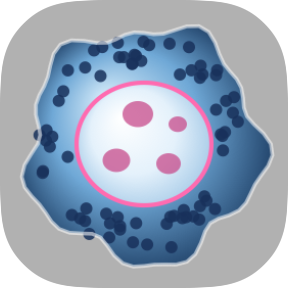
A pink ring rolls out from the germinal centre; every hidden clone it passes briefly shows its true face.
Every 6s, faster as the tumor grows
Clones flicker pink for 0.8s
From the Codex
A cancer of lymphocytes, the white cells that crowd lymph nodes. The cancerous cells look a lot like the healthy ones they came from, which is why it's diagnosed under the microscope.
Fun fact: The Epstein-Barr virus, which causes mononucleosis, is linked to several lymphomas, including Burkitt lymphoma.
The germinal centre swells, flashing, with a ring growing round it, then splits with a ring of shots and two new cells.
About every 8.5s, faster as it grows
1.4s window where it takes 160% damage
Split: 16 shots doing 8 damage each, plus 2 new cells in the crowd
From the Codex
A cancer of lymphocytes, the white cells that crowd lymph nodes. The cancerous cells look a lot like the healthy ones they came from, which is why it's diagnosed under the microscope.
Fun fact: The Epstein-Barr virus, which causes mononucleosis, is linked to several lymphomas, including Burkitt lymphoma.
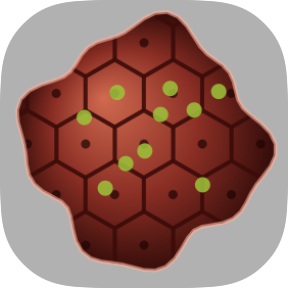
The colon tumor bursts out of a flashing crypt. Don't stand on it.
0.8s warning circle
Hits you for 10 if you're on the crypt when it surfaces
A decoy ripple heads to a different crypt each time it dives
From the Codex
A cancer of the gut lining. Most start as polyps, small growths on the wall of the colon, that turn cancerous over years; the cancer grows from the glands in the lining's crypts.
Fun fact: Removing polyps during a colonoscopy is one of the few ways to stop a cancer before it starts.
Polyps lob a glob toward you that leaves a caustic pool on the floor.
Every 5-7s per polyp
The pool lasts 4.5s and hurts while you stand in it
From the Codex
A cancer of the gut lining. Most start as polyps, small growths on the wall of the colon, that turn cancerous over years; the cancer grows from the glands in the lining's crypts.
Fun fact: Removing polyps during a colonoscopy is one of the few ways to stop a cancer before it starts.
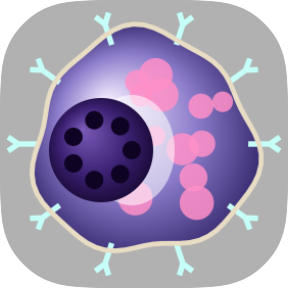
A spiral of Y-shaped antibodies that flare, then all turn at once toward where you are standing.
2 arms (3 from stage 4): 18 or 27 antibodies, 7 damage each
They flare as a warning, then 0.4s later lock on to your position
They fly to where you were, not where you go
From the Codex
A cancer of plasma cells in the bone marrow. One clone pumps out a single useless antibody (the M-protein) and stirs up bone-eating cells that punch holes in the bone.
Fun fact: Those 'punched-out' holes show up on X-rays of the skull like raindrops on a window.
Marked circles at and around you collapse into punched-out holes in the bone.
3 circles, +1 per two stages (max 5); the first is right on you
1s warning, 10 damage when it collapses
The hole lasts 6s and hurts while you stand in it
From the Codex
A cancer of plasma cells in the bone marrow. One clone pumps out a single useless antibody (the M-protein) and stirs up bone-eating cells that punch holes in the bone.
Fun fact: Those 'punched-out' holes show up on X-rays of the skull like raindrops on a window.
Myeloma clones fire single Y-shaped antibodies at you while circling at range.
Every 2.6-3.6s per clone
6 damage
From the Codex
A cancer of plasma cells in the bone marrow. One clone pumps out a single useless antibody (the M-protein) and stirs up bone-eating cells that punch holes in the bone.
Fun fact: Those 'punched-out' holes show up on X-rays of the skull like raindrops on a window.