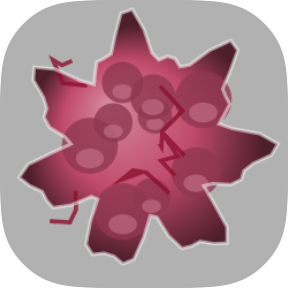
The host's white blood cells, antibodies and clotting fragments that fill every fight, from the Nasal Passage to the Brain. Each has its own way of hunting you, and any of them but the antibodies can show up as an elite.
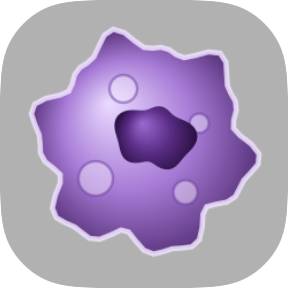
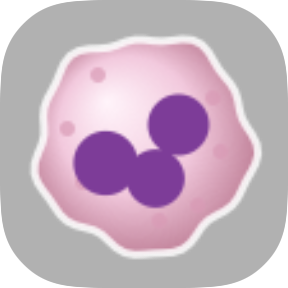
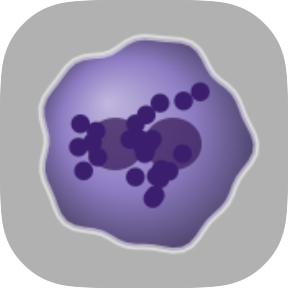
The usual first responder: a fast swarmer that rushes straight at you, weaving side to side, and hurts on contact. Weak alone, dangerous in packs.
Base stats: 30 health · 135 speed · 8 touch damage
No ranged attack; it only hurts by touching you
Organs: Nasal Passage, Lungs, Bloodstream, Gut, Liver, Bone Marrow
Also arrives in every hunter squad, in Antiviral and Interferon doses, as Mast Cell and Alveolar Macrophage reinforcements, from Hematopoietic Stem Cell summons, and 3 at a time when a Myeloblast dies
A Stem Cell Niche hazard releases two fresh neutrophils when you burst it
From the Codex
The most abundant white blood cell and a first responder. It has a multi-lobed nucleus and engulfs invaders.
Fun fact: Neutrophils can cast out sticky webs of DNA called NETs to trap microbes.
Tiny, fast and fragile Y-shaped antibodies that zig-zag straight at you and pop in one hit. A swarm joins every fight on top of the room's normal cells.
Base stats: 6 health · 215 speed (the fastest regular cell) · 4 touch damage
Every combat wave adds a swarm: up to about 5 in the first wave, 1–2 in reinforcement waves, more in deeper rooms and organs
Part of the normal cell mix in the Lymph Node, Gut and Brain
Plasmablasts keep budding more, and all three treatment doses bring big swarms
Never rolls an elite tier and never adapts in a Cytokine Storm
A kill raises Detection only a quarter as much as other cells and pays about a quarter of an ordinary cell's nucleotides (often none)
From the Codex
A Y-shaped protein made by B cells. Its two arms grab a specific part of a pathogen, marking it for destruction.
Fun fact: Your body can make billions of different antibodies, each one shaped for a different target.
Runs away from you, sliding along walls, and is worth chasing for its extra nucleotides. Pin it in a corner and it flashes red and turns on you.
Base stats: 48 health · 125 speed · 13 touch damage
Only bolts once you're well inside your auto-attack range, so you get shots in first
Wedged against a wall or corner while you're close: CORNERED! It hunts you hard and fast for about 3 seconds, then flees again (2.5 s before it can be cornered again)
Pays about 3.5x the nucleotides of an ordinary cell
A big, tanky cell that creeps after you, then swells and charges to engulf you down a marked red line. Lots of health and very heavy contact damage.
Base stats: 140 health · 64 speed · 18 touch damage (the toughest common cell of the early organs)
Every 1.4–2.4 s, when you're within 320 points and in sight: a 0.6 s wind-up (it swells and keeps creeping forward) behind a red warning line, then a straight charge that can't turn. The charge is sized to reach you: as far as you were when it wound up, plus 40 points (120–520 points), always in 0.42 s
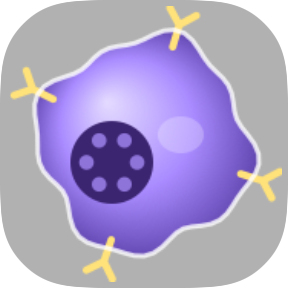
Weak but pushy: it chases you and pulses histamine that riles up every cell nearby and makes you swell up. When it dies, its heparin dissolves nearby clots.
Base stats: 55 health · 68 speed · 6 touch damage
Histamine pulse every 3.5–4.8 s, radius 200: cells inside move 35% faster and hit 30% harder for 2.5 s
If you're inside the pulse you're SWOLLEN: slowed to 60% speed for 1.2 s
On death, heparin dissolves every platelet clot within 220 points (HEPARIN: CLOTS DISSOLVED)
A mortar cell that keeps its distance and lobs three toxic granules at where you're heading. They land on warning circles and leave acid pools that burn anything inside, other cells included.
Base stats: 65 health · 70 speed · 8 touch damage
Keeps 200–300 points away; fires every 1.6–2.4 s when you're within 480
Leads its aim: one granule lands where you're going, two scatter around it
Each granule lands after 0.8 s on a warning circle and leaves an acid pool for 3 s
Acid burns you while you stand in it, and burns immune cells too (10 damage per second): lure them in
Organs: Lungs, Gut, Bone Marrow
From the Codex
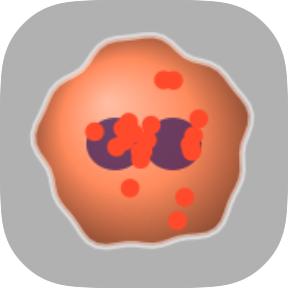
A granulocyte packed with toxic orange-red granules it sprays at parasites too big to swallow. It also drives the swelling in asthma and allergies.
Fun fact: Eosinophils are named for eosin, the pink-orange dye their granules soak up under the microscope.
Stalks you, then swells up and blasts perforin in a wide ring around itself for heavy damage. Back off or dash away when it swells.
Base stats: 80 health · 100 speed · 12 touch damage
Within 120 points it winds up for 0.65 s (swelling, with a red warning circle)
Perforin burst: radius 115, 20 base damage, then a 2.6 s cooldown
Organs: Bloodstream, Lymph Node, Brain
Also in hunter squads from the Bloodstream on, Interferon doses (the core of the dose), Plasma Cell reinforcements, Hematopoietic Stem Cell summons, and grown from Lymphoid Progenitors
From the Codex
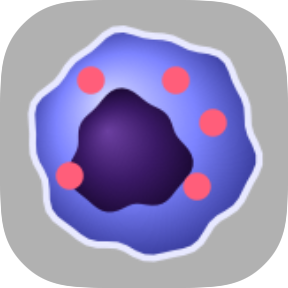
An innate lymphocyte that kills virus-infected and cancerous cells without needing prior training, using perforin and granzymes.
Fun fact: NK cells spot infected cells partly by what's missing: many viruses hide the cell's MHC markers, and NK cells notice.
Never attacks: it keeps its distance and studies you, glowing brighter. Let it watch you for 2.5 seconds and it presents your antigen to the whole immune system, then keeps doing it every 4 seconds until it dies.
Base stats: 60 health · 85 speed · no touch damage
Backs away inside 260 points, otherwise circles you
First presentation: counts while it can see you within 420 points; breaking line of sight pauses the count
ANTIGEN PRESENTED: Detection jumps by 18 and every unaware cell in the room is alerted
After that it presents again every 4 s for as long as it lives, whether it can see you or not (Latency and other hiding still pause it)
A badge over its head shows it: an eye with a ring filling while it studies you, then a pulsing gold "!" with the ring counting to the next presentation
Organs: Bloodstream, Lymph Node
From the Codex
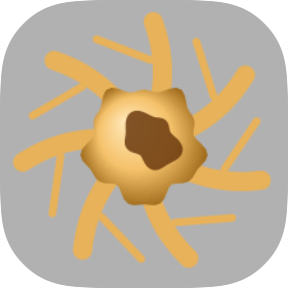
A sentinel cell with long branching arms that captures pathogens and presents their pieces (antigens) to T cells.
Fun fact: Dendritic cells are the bridge between innate and adaptive immunity; their discoverer won a Nobel Prize in 2011.