Every cell the host sends after you, and what it really does in your body.
A mass of the body's own cells dividing out of control. Some viruses, like Epstein-Barr (linked to nasopharyngeal carcinoma) and HPV, can help trigger cancers.
In the game
Every area grows its own cancer with its own fight: in the Nasal Passage a carcinoma shielded by nodules, in the Lungs an adenocarcinoma that seeds new nodules, in the Bloodstream leukemia, and deeper in lymphoma, colon carcinoma, hepatocellular carcinoma, multiple myeloma and glioblastoma. Destroying one pays out big. Left alone, a tumor grows on a timer (tougher, more satellites, faster attacks) and invades unexplored rooms. Leave the organ with it alive and it METASTASIZES: the next organ starts with a tumor at the same stage, still able to grow its full amount, and it sends squads of fast assassin cells after you (more often as it grows) until you destroy it.
Fun fact: Oncolytic viruses are engineered to infect and burst cancer cells; one (T-VEC, a modified herpes virus) is approved to treat melanoma.
Appears inTumors & MetastasisOrgan CancersTumor PartsTumor AttacksRun ModifiersModifier CombosHosts & Genome
A cancer of blood-forming cells: immature white cells called blasts crowd the blood and bone marrow.
In the game
Blasts divide every few seconds and burst out toward you, and every few seconds each one throws a needle-like Auer rod at you. The stem cell keeps budding more; its first six circle it as a living wall, and while three of them are close it takes 65% less damage (a gold ring shows it). The more blasts there are, the thicker the blood: up to 25% slower at 32. Kill the gold-tinted leukemic stem cell and the whole leukemia collapses.
Fun fact: Many leukemias are thought to be driven by a small population of leukemic stem cells.
Appears inOrgan CancersTumor PartsTumor Attacks
A cancer of lymphocytes, the white cells that crowd lymph nodes. The cancerous cells look a lot like the healthy ones they came from, which is why it's diagnosed under the microscope.
In the game
Lymph Node tumor. Lymphoma clones hide among harmless lymphocytes that look exactly the same; a clone shows its true face when you get close or hit it, and its scan pulse makes clones flicker pink. The germinal centre shrugs off most damage, except while it swells to split, which ends in a ring of shots and two more cells.
Fun fact: The Epstein-Barr virus, which causes mononucleosis, is linked to several lymphomas, including Burkitt lymphoma.
Appears inOrgan CancersTumor PartsTumor Attacks
A cancer of the gut lining. Most start as polyps, small growths on the wall of the colon, that turn cancerous over years; the cancer grows from the glands in the lining's crypts.
In the game
Gut tumor. The core hides down in one of several crypts and can't be hurt there; a ripple runs under the floor to where it will surface, with a decoy ripple to another crypt. It bursts out after a warning circle, fires for a few seconds, then dives again. Polyps on the walls bud more polyps and drip caustic pools.
Fun fact: Removing polyps during a colonoscopy is one of the few ways to stop a cancer before it starts.
Appears inOrgan CancersTumor PartsTumor Attacks
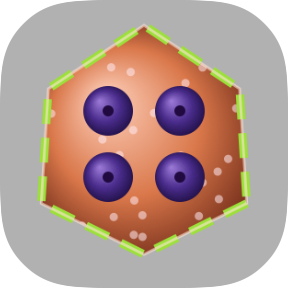
The most common liver cancer, growing from the liver's main cells, hepatocytes. Hepatitis B and C infections are among its biggest causes.
In the game
Liver tumor. Satellite lobes feed the core through vessels: while any lobe lives it regenerates and takes half damage. A destroyed lobe regrows after a few seconds, so kill them all in quick succession: the core turns cirrhotic, stops regenerating and takes extra damage for a while. It lobs bile arcs and sprays that splash where the circles warn.
Fun fact: The liver can regrow from as little as a quarter of its mass, and this cancer borrows that talent.
Appears inOrgan CancersTumor PartsTumor Attacks
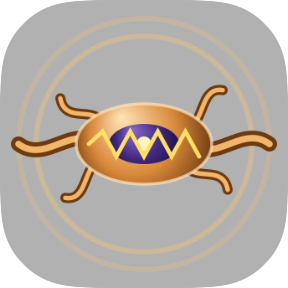
A cancer of plasma cells in the bone marrow. One clone pumps out a single useless antibody (the M-protein) and stirs up bone-eating cells that punch holes in the bone.
In the game
Bone Marrow tumor. A plasma-cell core drifting in slow circles. It fires spirals of Y-shaped antibodies that flare, then all turn at once toward where you stand, and punches bone lesions: marked circles that collapse into holes that hurt while you stand in them. It keeps budding small myeloma clones.
Fun fact: Those 'punched-out' holes show up on X-rays of the skull like raindrops on a window.
Appears inOrgan CancersTumor PartsTumor Attacks
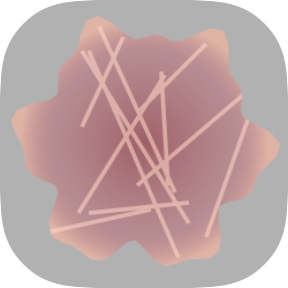
The most aggressive brain tumor, grown from glial cells. It sends thin tendrils deep into the surrounding brain, so it can never be fully cut out.
In the game
Brain tumor. Tendrils creep slowly across the floor at you from the nearest glial nodes and the core, hold, then pull back; touching one hurts. Every few seconds the core marks a node, slips under the floor (it can't be hurt while moving) and comes up there with two pulse rings of shots, each with a gap. Destroy the nodes to cut its tendrils and leave it stranded and weaker.
Fun fact: Its cells crawl along nerve fibres and blood vessels, sometimes crossing to the other half of the brain.
Appears inOrgan CancersTumor PartsTumor Attacks
Nasopharyngeal carcinoma grows from squamous cells, flat scale-like cells that line the throat behind the nose. Its cells can break off and travel through lymph.
In the game
The Nasal Passage cancer's assassin: a dart of keratin scales. Stalks you nearly invisible, marks a line and pounces; its bite marks you to take more damage.
Fun fact: It's far more common in southern China and Southeast Asia, partly because of the Epstein-Barr virus.
Appears inAssassin Squads
Lung adenocarcinoma can spread 'lepidically', creeping along the walls of the air sacs like butterflies on a fence.
In the game
The Lungs cancer's assassin: a lacy cell on membrane wings. Its pounce glides further than the others, down a longer marked line.
Fun fact: Tumor cells can even spread through the airways themselves, riding air into new parts of the lung.
Appears inAssassin Squads
In acute myeloid leukemia, blasts can carry Auer rods: needle-shaped crystals of enzymes that are a telltale sign under the microscope.
In the game
The Bloodstream cancer's assassin: a blast bristling with Auer rods. Faster than any other assassin.
Fun fact: Auer rods are named after John Auer, who described them in 1906.
Appears inAssassin Squads
Hodgkin lymphoma is defined by Reed-Sternberg cells: huge cells with two mirror-image nuclei that look like owl eyes, hiding among many normal immune cells.
In the game
The Lymph Node cancer's assassin. Instead of cloaking it looks like an ordinary lymphocyte until it gets close, then shows its owl eyes and pounces.
Fun fact: In a Hodgkin lymphoma tumor, the cancer cells are often less than 1% of the mass; the rest are normal cells they've recruited.
Appears inAssassin Squads
Signet-ring cells are cancer cells so full of mucus that the nucleus is squashed to one side, like a ring's signet. They spread by slipping silently through tissue.
In the game
The Gut cancer's assassin. Almost completely invisible at range, though a little slower than the others; watch for its marked line.
Fun fact: Signet-ring carcinomas often spread before they cause any symptoms at all.
Appears inAssassin Squads
Liver cancer cells keep the hepatocyte's knack for dividing back after damage, and still make bile, sometimes in tiny green threads.
In the game
The Liver cancer's assassin: a hexagonal cell threaded with bile. Leave it alone for a moment and it heals itself, so finish it once you start.
Fun fact: A healthy liver regrows to full size within weeks of losing most of itself.
Appears inAssassin Squads
Myeloma cells signal osteoclasts, the bone-eating cells, to dissolve bone around them, leaving lytic lesions.
In the game
The Bone Marrow cancer's assassin: a jagged bone shard. Where its pounce lands it punches a small lesion that hurts to stand in.
Fun fact: Bone pain, often in the back or ribs, is the most common first sign of multiple myeloma.
Appears inAssassin Squads
Glioma cells squeeze through tiny gaps between brain cells, changing shape to crawl along nerve fibres far from the main tumor.
In the game
The Brain cancer's assassin, trailing long processes. After its pounce it re-aims and pounces a second time, straight away.
Fun fact: Glioma cells can shrink their volume by a third to slip through the brain's narrow spaces.
Appears inAssassin Squads
A Y-shaped protein made by B cells. Its two arms grab a specific part of a pathogen, marking it for destruction.
In the game
Tiny, fast and fragile. Antibodies swarm in every fight; one hit pops them, but packs add up.
Fun fact: Your body can make billions of different antibodies, each one shaped for a different target.
Appears inFirst Responders
The largest white blood cell in the blood. Monocytes patrol, then leave the bloodstream and mature into macrophages.
In the game
Runs from you and drops extra nucleotides. Corner it against a wall and it turns and hunts you hard for a few seconds.
Fun fact: About half of your body's monocytes wait in reserve in the spleen.
Appears inFirst Responders
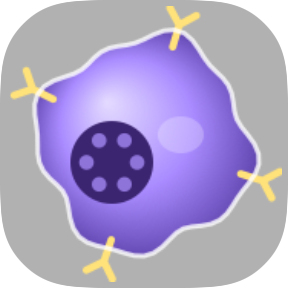
An early plasma cell: an activated B cell that pours out antibodies within days of an infection.
In the game
Hangs back at range and keeps budding new antibodies. Kill it first or the swarm never ends.
Fun fact: One plasma cell can release thousands of antibody molecules every second.
Appears inFirst Responders
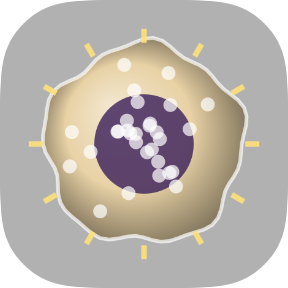
The most abundant white blood cell and a first responder. It has a multi-lobed nucleus and engulfs invaders.
In the game
A fast swarmer that chases you down. Weak alone, dangerous in packs.
Fun fact: Neutrophils can cast out sticky webs of DNA called NETs to trap microbes.
Appears inFirst RespondersMilestone ChallengesEndless Game Mode
A large white blood cell that eats pathogens and dead cells by phagocytosis, then shows pieces of them to other immune cells.
In the game
A tanky cell that charges to engulf you down a marked line. As Retrovirus, kill it with your shots and Integration Surge can bring it back as an ally that guards you.
Fun fact: The name comes from Greek for "big eater".
Appears inRetrovirusFirst RespondersHosts & GenomeGear SourcesThe Codex
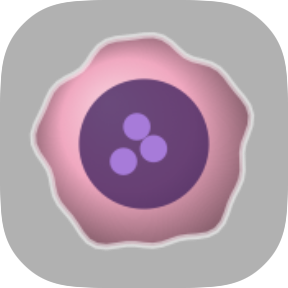
A lymphocyte that makes antibodies tailored to a specific pathogen.
In the game
Keeps its distance and fires antibodies that slow you.
Fun fact: After an infection, memory B cells can stay in the body for years.
Appears inFirst Responders
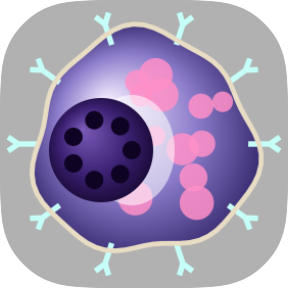
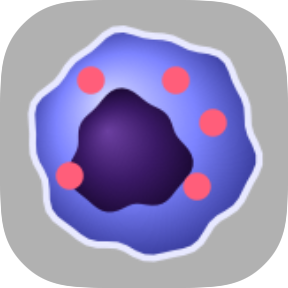
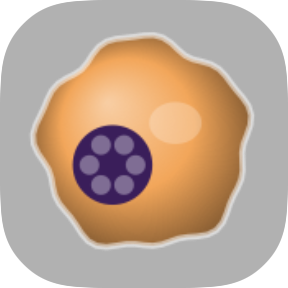
A tissue cell packed with granules of histamine and other chemicals that it releases to start inflammation.
In the game
Boss of the Nasal Passage: histamine bursts, sneeze shockwaves (dash through them), a charge that leaves it exposed, and neutrophil calls when wounded.
Fun fact: Mast cells are best known for allergic reactions, but they also guard the nose, lungs and skin against infection.
Appears inOrgan BossesBoss Sets
The lungs' resident macrophage. It patrols the air sacs and swallows dust, microbes and debris that get past the airways.
In the game
Final boss in the Lungs: pseudopod lashes, an engulf pull (its core takes double damage) and surfactant bubbles.
Fun fact: In smokers they fill up with soot, so pathologists sometimes call them "dust cells".
Appears inOrgan BossesBoss Sets
Tiny cell fragments in the blood that clump together and plug wounds, forming clots with fibrin.
In the game
Fast, fragile swarmers in the Bloodstream. They leave sticky clots where they die.
Fun fact: Platelets also help the immune system: they can trap bacteria and viruses and release antimicrobial proteins.
Appears inFirst RespondersPetri Lab
An innate lymphocyte that kills virus-infected and cancerous cells without needing prior training, using perforin and granzymes.
In the game
Stalks you, then charges a perforin burst around itself. Back off or dash away when it swells.
Fun fact: NK cells spot infected cells partly by what's missing: many viruses hide the cell's MHC markers, and NK cells notice.
Appears inFirst Responders
A sentinel cell with long branching arms that captures pathogens and presents their pieces (antigens) to T cells.
In the game
Harmless on its own, but if it watches you too long it presents your antigen: big Detection spike and the room is alerted. Then it keeps presenting every 4 seconds until it dies (the ring over its head counts down). Kill it first.
Fun fact: Dendritic cells are the bridge between innate and adaptive immunity; their discoverer won a Nobel Prize in 2011.
Appears inFirst Responders
A cascade of blood proteins that tag pathogens and assemble the membrane attack complex, a pore that punches holes in membranes.
In the game
Stationary turrets that fire slow orbs that curve toward you.
Fun fact: There are over 30 complement proteins, and they make up about 10% of the proteins in your blood.
Appears inFirst Responders
A fully matured B cell that has become an antibody factory, packed with endoplasmic reticulum.
In the game
Boss of the Bloodstream: antibody fans, an opsonizing lock-on volley (you take 35% more damage for 5s), platelet swarms and a turning Immunoglobulin wall you have to circle around.
Fun fact: A single plasma cell can release around 2,000 antibodies every second.
Appears inOrgan BossesBoss Sets
A "killer" T cell that hunts down infected cells and destroys them by punching holes with perforin and injecting granzymes.
In the game
A mini-boss sent when Detection hits 100 (from the Lungs on; in the Nasal Passage only for its first appearance). It lunges at you and follows you between rooms, and drops rare loot. Every generation you destroy, the next takes longer to come but is tougher, learns new skills, and later ones hunt in packs.
Fun fact: Each killer T cell is trained to recognise one specific antigen, then multiplies into an army once it finds a match.
Appears inKiller T CellsRun ModifiersModifier CombosHosts & GenomeGear Sources
A CD4 T cell that coordinates the immune response, releasing cytokines that switch on other immune cells. HIV's main target.
In the game
Keeps its distance and pulses cytokines: nearby cells get faster and hit harder for a few seconds. Kill it first.
Fun fact: Losing helper T cells is what turns HIV infection into AIDS.
Appears inDeep Organ Cells
A web-like cell in lymph node follicles that holds antigens on its surface for B cells to inspect.
In the game
Doesn't move. Surrounded by a web that slows you, and fires slowing rings of shots.
Fun fact: FDCs can hold on to antigens for months, helping build long-lasting immunity.
Appears inDeep Organ Cells
A cup-shaped cell in the gut and airway lining that secretes mucus to trap microbes.
In the game
Lobs blobs of mucus at you: a warning circle, then a slowing puddle that hurts if you're inside.
Fun fact: Goblet cells can refill and release mucus within minutes.
Appears inDeep Organ Cells
A plasma cell that makes IgA, the antibody that guards mucosal surfaces like the gut.
In the game
Keeps range and fires spreads of sticky, slowing antibodies.
Fun fact: Your body makes more IgA than all other antibodies combined: several grams a day.
Appears inDeep Organ Cells
A star-shaped liver cell that stores vitamin A; when the liver is injured it turns into a scar-making cell.
In the game
Weaves toward you, leaving patches of scar tissue that slow you.
Fun fact: Stellate cells are the main driver of liver fibrosis and cirrhosis.
Appears inDeep Organ Cells
A T cell with natural killer features, abundant in the liver, that reacts within hours.
In the game
Nearly invisible. It reveals itself with a '!' right next to you, then lunges.
Fun fact: Up to 30% of the liver's lymphocytes can be NKT cells.
Appears inDeep Organ Cells
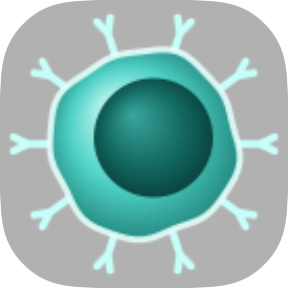
A giant bone marrow cell that sheds thousands of platelets from its edges.
In the game
Huge and tough, it keeps shedding platelet swarms and bursts a ring of fragments when you get close. Kill it to stop them.
Fun fact: One megakaryocyte can release up to 3,000 platelets.
Appears inDeep Organ Cells
An immature white blood cell that will develop into a neutrophil or other granulocyte.
In the game
Fast. When it dies it bursts into three neutrophils.
Fun fact: Too many myeloblasts in the blood is a sign of acute myeloid leukemia.
Appears inDeep Organ Cells
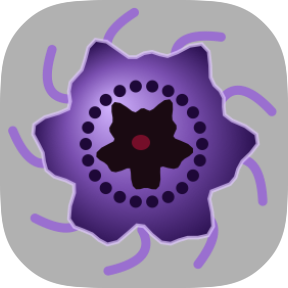
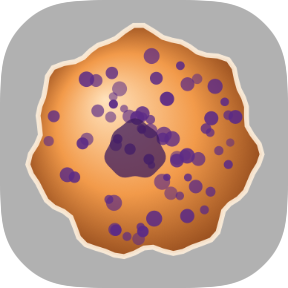
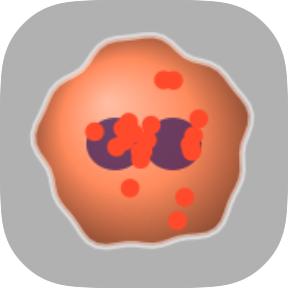
A granulocyte packed with toxic orange-red granules it sprays at parasites too big to swallow. It also drives the swelling in asthma and allergies.
In the game
Keeps its distance and lobs three toxic granules at where you're heading. They land on warning circles and leave acid pools that burn anything inside for 3 seconds, cells included.
Fun fact: Eosinophils are named for eosin, the pink-orange dye their granules soak up under the microscope.
Appears inFirst Responders
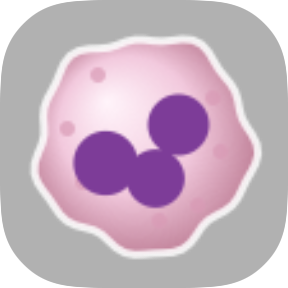
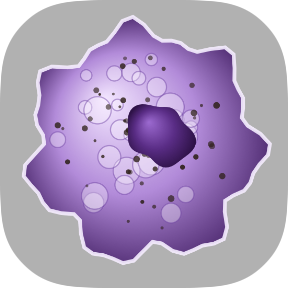
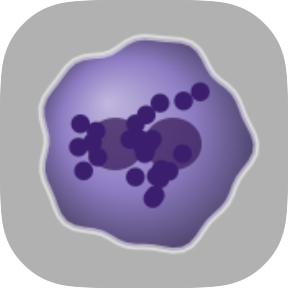
The rarest white blood cell. Its dark granules hold histamine, the alarm signal behind allergies, and heparin, which stops blood from clotting.
In the game
Weak but pushy: it chases you, and every few seconds it pulses histamine: nearby cells speed up and hit harder, and you swell up and slow down if you're in it. When it dies its heparin dissolves any platelet clots nearby.
Fun fact: Basophils make up less than 1% of your white blood cells, yet help trigger severe allergic reactions.
Appears inFirst Responders
A long-lived B cell left over from an earlier infection. It remembers the invader and answers much faster and harder the next time.
In the game
Fires a fast aimed burst the moment it spots you, then steady aimed volleys. It remembers the last shot type that hit it and takes half damage from it until a different type hits.
Fun fact: Memory B cells are why vaccines work: they keep the recipe for the right antibody for years, sometimes decades.
Appears inFirst RespondersAdaptive Immunity
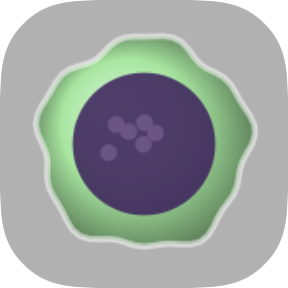
The parent cell of every lymphocyte: in the bone marrow it matures into B cells, T cells and natural killer cells.
In the game
Slow, weak and harmless, with a ring that fills over 6 seconds. When it fills, it becomes a full B cell, NK cell or helper T cell (rarely a weakened Killer T clone). Kill it first.
Fun fact: One stem cell line can give rise to every kind of immune cell in your body.
Appears inDeep Organ CellsHosts & Genome
A young T cell in training in the thymus. It is tested against the body's own proteins, and most fail and die.
In the game
Small and fragile, they drift around you in packs. Whenever you dash, every thymocyte nearby dashes straight at you too. About a third fail selection and die on their own.
Fun fact: Over 95% of thymocytes never graduate: they're eliminated for being useless or for attacking the body itself.
Appears inDeep Organ Cells
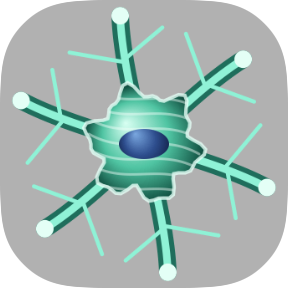
A star-shaped brain cell that supports neurons and helps form the blood-brain barrier.
In the game
Shields up to three nearby cells at a time. Kill it to strip their protection.
Fun fact: Astrocytes are the most numerous cells in the brain.
Appears inDeep Organ Cells
A memory T cell that stays in a tissue for good instead of circulating, ready to strike reinfections immediately.
In the game
Teleports right next to you and fires a five-shot burst.
Fun fact: Brain-resident memory T cells can persist for years after an infection.
Appears inDeep Organ Cells
A helper T cell that directs B cells in germinal centres, deciding which ones become antibody factories.
In the game
Boss of the Lymph Node. Calls a cytokine storm (every cell faster and shielded), summons B cells and helper T cells, and fires bursts and shockwaves.
Fun fact: Germinal centres are where antibodies evolve to bind ever more tightly.
Appears inOrgan BossesBoss Sets
A gut cell at the base of intestinal crypts that releases antimicrobial proteins called defensins.
In the game
Boss of the Gut. Fires spiral defensin streams, mucus barrages, bubbles and aimed fans.
Fun fact: Paneth cells also guard the gut's stem cells right next to them.
Appears inOrgan BossesBoss Sets
The liver's resident macrophage, lining its blood vessels and filtering out bacteria, viruses and old red cells.
In the game
Boss of the Liver. Lashes with pseudopods, engulfs you (its core takes double damage), drops scar pools and charges.
Fun fact: Kupffer cells make up most of the body's tissue macrophages.
Appears inOrgan BossesBoss Sets
The stem cell that gives rise to every blood and immune cell.
In the game
Boss of the Bone Marrow. Keeps creating cells: neutrophils, myeloblasts, platelets, even megakaryocytes and NK cells, between bursts, spirals and shockwaves.
Fun fact: A single transplanted stem cell can rebuild a mouse's whole blood system.
Appears inOrgan BossesBoss Sets
The brain's resident immune cells, constantly sweeping with branching arms and swallowing debris or invaders.
In the game
The final boss. Lashes in every direction, spirals, summons astrocytes and memory T cells, engulfs and charges.
Fun fact: Microglia also prune unused synapses as the brain develops.
Appears inOrgan BossesBoss Sets
A mucus plug: a thick wad of mucins and trapped debris that can block an airway or duct outright, as happens in asthma and cystic fibrosis.
In the game
Key guardian of the Mucolytic Enzyme in the Nasal Passage. Lobs globs that leave slowing mucus puddles, sprays sticky shots, and engulfs: it pulls you in for a moment.
Fun fact: Mucolytic drugs like N-acetylcysteine break the sugar-protein bonds that make mucus so sticky.
Appears inKey Guardians & Genes
A giant cell with many nuclei, formed when neighbouring cells fuse their membranes into one. Viruses like RSV and measles cause them with their fusion proteins.
In the game
Key guardian of the Fusion Peptide in the Lungs. Marks a line and lunges down it, landing in a ring of membrane shards; fires double rings; splits off fused fragments at 2/3 and 1/3 health.
Fun fact: Your muscle fibres and part of the placenta are natural syncytia; the placenta's fusion gene came from an ancient retrovirus.
Appears inKey Guardians & Genes
Fibrin is the protein mesh that turns a platelet plug into a solid clot. Plasmin, made from plasminogen, is the enzyme that dissolves it.
In the game
Key guardian of the Plasminogen Activator in the Bloodstream. Keeps its distance, drops rings of sticky clots around you, fires stretching threads of slowing fibrin, and calls in platelets.
Fun fact: Clot-busting stroke drugs like alteplase work by activating plasminogen, exactly what this game's key does.
Appears inKey Guardians & Genes
Fibroblastic reticular cells: star-shaped cells that weave a lymph node's scaffolding, wrapping collagen fibres into conduits that carry small molecules from the lymph straight to waiting immune cells.
In the game
Key guardian of the Plasminogen Activator in the Lymph Node. Darts around you, strings a cage of conduit threads around you that closes to nothing (one side is left open), sweeps a thread around itself, and fires volleys down its arms.
Fun fact: Immune cells crawl along this network like roads, and the same cells release the chemokines that guide T cells to their zone.
Appears inKey Guardians & Genes
Interstitial cells of Cajal: pacemaker cells in the gut wall that generate the electrical slow waves setting the rhythm of its muscle contractions.
In the game
Key guardian of the Mucolytic Enzyme in the Gut. Sends peristaltic waves across the whole room, each with a gap to slip through; squeezes alternate strips of the floor in turn (segmentation); and sprays slowing mucus.
Fun fact: Santiago Ramón y Cajal, who described them in 1893, is also called the father of modern neuroscience and won the 1906 Nobel Prize.
Appears inKey Guardians & Genes
Hepatocytes are the liver's main cells and do most of its metabolism and detox. Many carry extra chromosome sets or two nuclei (polyploidy), and each works differently depending on its zone between the portal and central veins.
In the game
Key guardian of the Fusion Peptide in the Liver. Circles you; turns two of the three rings around itself toxic, then flips them (metabolic zonation); bursts bile along a star of lines through you; and lobs bile that pools.
Fun fact: The liver can grow back from as little as a third of its mass, mostly by its hepatocytes dividing again.
Appears inKey Guardians & Genes
A huge cell with many nuclei that dissolves bone: it seals onto the surface and pumps out acid and enzymes under its ruffled border. With bone-building osteoblasts it constantly remodels the skeleton.
In the game
Key guardian of the Mucolytic Enzyme in the Bone Marrow. Burrows after you, out of reach, and erupts where it ends up in a ring of bone shards, leaving a resorption pit; lobs acid that etches more pits; and collapses the bone in a rolling line.
Fun fact: Thanks to osteoclasts and osteoblasts, about a tenth of your skeleton is replaced every year.
Appears inKey Guardians & Genes
Giant pyramidal neurons of the motor cortex, the biggest nerve cells in the brain. Their axons run all the way down the spinal cord to drive your muscles.
In the game
Key guardian of the Fusion Peptide in the Brain. Leaps in a chain along flashing lines that discharge behind it, then goes refractory: for a moment it can't act and takes double damage. Also fires fans of dendritic discharges and bursts of synaptic vesicles.
Fun fact: Signals jump between the gaps in an axon's myelin sheath (saltatory conduction) at over 100 metres per second.
Appears inKey Guardians & Genes