Antibodies, cytokines and the rest of the chemistry of a fight.
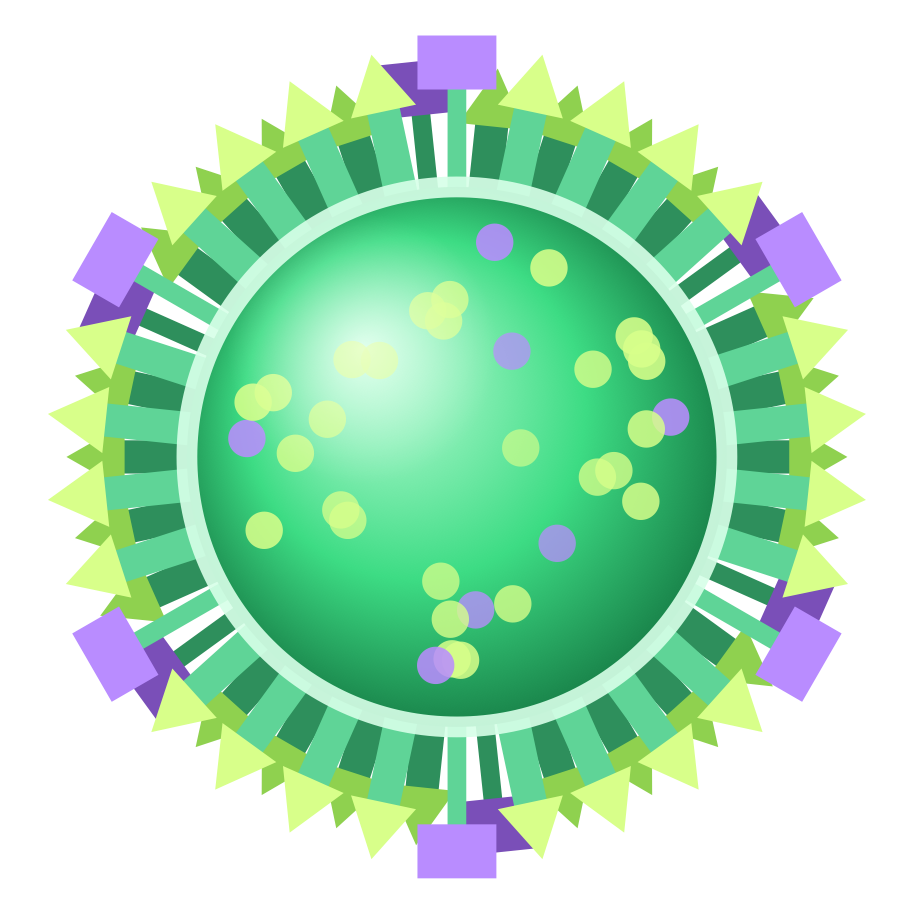
The spike protein on the flu virus that latches onto sialic acid receptors on the surface of host cells.
In the game
Influenza's club-shaped spikes, and the name of the offensive gear set.
Fun fact: It's the "H" in H1N1, and the main target of flu vaccines.
Appears inHosts & Genome
A flu enzyme that cuts the virus free from the host cell so new virions can spread.
In the game
The Neuraminidase Boost mutation and Neuraminidase Cleave upgrade make shots pierce.
Fun fact: Antiviral drugs like oseltamivir work by blocking it.
Appears inPetri Lab
A Y-shaped protein made by B cells that binds to a specific part of a pathogen, marking it for destruction.
In the game
B-cell shots: getting hit slows you briefly.
Fun fact: Your body can make billions of different antibodies.
Appears inRetrovirusHosts & GenomeEndless Boons & CursesThe Codex
A chemical released by mast cells that widens blood vessels, makes tissues swell and increases mucus.
In the game
The Mast Cell's orange bullet bursts.
Fun fact: Antihistamines relieve allergy symptoms by blocking its receptors.
The enzyme that copies a virus's genome. RNA viruses carry their own RNA-dependent RNA polymerase, which cells don't have.
In the game
Polymerase Shards: the common enhancement material. About 1 in 5 kills drops one, and vesicle chests hold several.
Fun fact: Because cells lack this enzyme, it's a prime drug target: remdesivir and favipiravir both jam viral polymerases.
Appears inRival VirusesDrops & PickupsCurrencies & MaterialsEnhancingEnhancement MaterialsEndless Game Mode
Helper proteins (like heat-shock proteins) that guide other proteins into their correct folded shape.
In the game
Chaperone Proteins: the uncommon enhancement material, needed from +1. Dropped by Killer T cells, bosses, chests and puzzles.
Fun fact: Many viruses hijack host chaperones such as HSP70 and HSP90 to fold their own proteins.
Appears inDrops & PickupsCurrencies & MaterialsEnhancement Materials
RNA molecules that act as enzymes, cutting and joining RNA without any protein help.
In the game
Ribozyme Cores: the rare enhancement material, needed from +3 up to +10. They only drop in Endless Game Mode: every set pays one (more as sets climb), and its bosses, Killer T cells and elites drop them too. Anywhere else the same drops condense into chaperones.
Fun fact: The ribosome's core catalytic site is a ribozyme, a living fossil of an early "RNA world".
Appears inDrops & PickupsCurrencies & MaterialsEnhancingEnhancement MaterialsPandemic Game ModeEndless Game Mode
A stringy protein that weaves platelets into a solid clot. Plasmin, made from plasminogen, breaks it back down.
In the game
Fibrin clots seal some Bloodstream doors. The Plasminogen Activator gene dissolves them and stops platelet clots slowing you.
Fun fact: Clot-busting drugs given after strokes are plasminogen activators.
Appears inKey Guardians & GenesTissue Hazards & TerrainSealed Doors & Genes
Ribonucleic acid: a single-stranded cousin of DNA that carries genetic messages and, in many viruses, the whole genome.
In the game
A rare purple drop: every third level of a Petri Lab upgrade costs RNA, the advanced upgrades need it to unlock, and respeccing your skill tree costs it too. It only drops in Pandemic Game Mode (from kills, Killer T cells, bosses, puzzles and tumors), and taking cities and continents pays more. Anywhere else it breaks down into nucleotides.
Fun fact: Some RNA molecules can act as enzymes (ribozymes), which hints that early life may have run on RNA alone.
Appears inDrops & PickupsXP & LevelsPetri LabCurrencies & Materials
The building block of DNA and RNA: a sugar, a phosphate and a base (A, T, C, G in DNA; A, U, C, G in RNA).
In the game
Currency. A, T, C and G drop separately (G is the rarest) and buy Petri Lab upgrades. Salvaged gear returns them.
Fun fact: Influenza stores its genes as RNA, so it uses U in place of T.
Appears inTumor RewardsTrade-off AltarsRoom TraitsDrops & PickupsRun ModifiersModifier CombosMilestone ChallengesCurrencies & MaterialsLineage & GenerationsHosts & GenomeCombiningGear Screen & BagEnhancement MaterialsInfect Game ModeMenus & MetaEndless Boons & Curses
Small signalling proteins immune cells release to call for help, coordinate an attack and trigger inflammation.
In the game
When a cell spots you it signals others: Detection rises and hunter squads are sent at 35, 60 and 80, and every kill pushes it higher.
Fun fact: When the release spirals out of control it's called a cytokine storm, and it can harm the body more than the virus.
Appears inAdaptive ImmunityRun ModifiersPandemic Game Mode
Damage-associated molecular patterns: molecules spilled by injured or dying cells that warn the immune system something is wrong.
In the game
Every kill raises Detection, and each one adds more the more you have killed this run. Quiet kills of unaware cells count half.
Fun fact: Messy cell death raises the alarm; quiet, tidy cell death (apoptosis) mostly doesn't.
A retroviral enzyme that copies RNA into DNA, the reverse of the usual flow of genetic information.
In the game
Retrovirus's reservoir (the cells its shots kill) and its Integration Surge ultimate, which brings them back as allies.
Fun fact: It's so error-prone that HIV mutates constantly, which is why it escapes the immune system and drugs.
Appears inRetrovirusPetri Lab
Large, sugar-coated proteins that give mucus its sticky, gel-like texture.
In the game
The Mucolytic Enzyme gene: dissolves mucus plugs, and mucus stops slowing you.
Fun fact: Influenza's neuraminidase cuts through mucins' sugar chains to reach the cells beneath.
Appears inKey Guardians & GenesSealed Doors & GenesRun Modifiers
A short stretch of a viral protein that jams into a cell membrane and helps merge the virus with it.
In the game
The Fusion Peptide gene: opens tight junctions, and your dash damages cells you pass through.
Fun fact: Enveloped viruses like flu and HIV both use fusion peptides to unload their genomes into cells.
Appears inKey Guardians & GenesSealed Doors & Genes
A film of lipids and proteins coating the alveoli that lowers surface tension so they don't collapse when you breathe out.
In the game
The Alveolar Macrophage's bubbles, which pop into rings of shots.
Fun fact: Premature babies can lack surfactant, so doctors may give it to them as a treatment.
Leftover DNA from ancient retroviruses that infected our ancestors and became a permanent part of the human genome.
Fun fact: Around 8% of human DNA comes from ERVs. Some of it even helps build the placenta.
Appears inRetrovirusPetri LabHosts & Genome