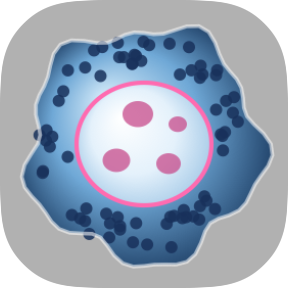
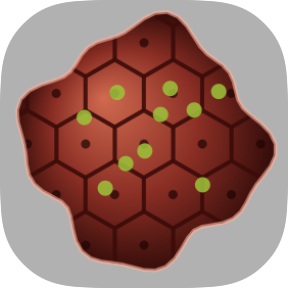
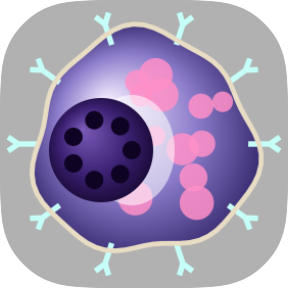
A lumpy, irregular mass with crusty nodules and tangled blood vessels. It never moves, and touching it hurts.
The toughest part of the fight (base health 525, scaled by organ and stage)
Breathes slowly, and swells briefly before every attack
Nasal Passage: shielded by nodules; Lungs: keeps regrowing
Destroying it collapses the whole tumor
From the Codex
A mass of the body's own cells dividing out of control. Some viruses, like Epstein-Barr (linked to nasopharyngeal carcinoma) and HPV, can help trigger cancers.
Fun fact: Oncolytic viruses are engineered to infect and burst cancer cells; one (T-VEC, a modified herpes virus) is approved to treat melanoma.
A smaller, stationary lump around the core that keeps budding clone cells.
Base health 90
Buds a clone cell every 4.5-6s
In the Nasal Passage, nodules shield the core
In the Lungs, every nodule speeds up the core's regrowth
From the Codex
A mass of the body's own cells dividing out of control. Some viruses, like Epstein-Barr (linked to nasopharyngeal carcinoma) and HPV, can help trigger cancers.
Fun fact: Oncolytic viruses are engineered to infect and burst cancer cells; one (T-VEC, a modified herpes virus) is approved to treat melanoma.
A small, misshapen cell with an oversized nucleus that rushes straight at you.
Fast (one of the quickest cells in the fight) but fragile
Budded by nodules: up to 10 alive at once, +3 per stage
Cells budded mid-fight pay no nucleotides
From the Codex
A mass of the body's own cells dividing out of control. Some viruses, like Epstein-Barr (linked to nasopharyngeal carcinoma) and HPV, can help trigger cancers.
Fun fact: Oncolytic viruses are engineered to infect and burst cancer cells; one (T-VEC, a modified herpes virus) is approved to treat melanoma.
A dark cell the lung tumor launches toward a pulsing pink ring. Shoot it down before it lands.
Launched 2 at a time
Drifts slowly to a spot at least a short distance from the core
If it reaches its ring it takes root as a new nodule (SEEDED)
From the Codex
A mass of the body's own cells dividing out of control. Some viruses, like Epstein-Barr (linked to nasopharyngeal carcinoma) and HPV, can help trigger cancers.
Fun fact: Oncolytic viruses are engineered to infect and burst cancer cells; one (T-VEC, a modified herpes virus) is approved to treat melanoma.
An ordinary small lymphocyte drifting around the follicle. It never attacks, but it looks exactly like a lymphoma clone.
6 at stage 1, +1 per stage (up to 10)
Touching it does no damage
From the Codex
A cancer of lymphocytes, the white cells that crowd lymph nodes. The cancerous cells look a lot like the healthy ones they came from, which is why it's diagnosed under the microscope.
Fun fact: The Epstein-Barr virus, which causes mononucleosis, is linked to several lymphomas, including Burkitt lymphoma.
A cancer cell wearing a harmless lymphocyte's face. Get close or hit it and it shows its swollen, notched nucleus (CLONE!) and hunts you.
Twice as tough as a harmless lymphocyte
Reveals itself when you come close or hit it
On reveal it fires a 5-shot spread, then chases you and fires 3-shot spreads every 2.6-3.4s
The scan pulse makes hidden clones flicker pink for a moment
Clones you kill stay dead if you leave and come back
From the Codex
A cancer of lymphocytes, the white cells that crowd lymph nodes. The cancerous cells look a lot like the healthy ones they came from, which is why it's diagnosed under the microscope.
Fun fact: The Epstein-Barr virus, which causes mononucleosis, is linked to several lymphomas, including Burkitt lymphoma.
The lymphoma core: a lymph follicle gone wrong, with a dark mantle of packed cells around a pale, swollen centre.
Takes 40% damage, but 160% while swelling
Splits into 2 more cells after each swell
From the Codex
A cancer of lymphocytes, the white cells that crowd lymph nodes. The cancerous cells look a lot like the healthy ones they came from, which is why it's diagnosed under the microscope.
Fun fact: The Epstein-Barr virus, which causes mononucleosis, is linked to several lymphomas, including Burkitt lymphoma.
A tan, cauliflower-like adenocarcinoma riddled with malformed glands. It moves between crypts under the floor.
Can't be hurt while it's down in a crypt
Surfaces for 4.6s at a time
From the Codex
A cancer of the gut lining. Most start as polyps, small growths on the wall of the colon, that turn cancerous over years; the cancer grows from the glands in the lining's crypts.
Fun fact: Removing polyps during a colonoscopy is one of the few ways to stop a cancer before it starts.
A dark well in the gut lining, ringed by goblet cells, where the colon tumor hides.
4 per fight (5 from stage 3)
Flashes before the tumor bursts out of it
From the Codex
A cancer of the gut lining. Most start as polyps, small growths on the wall of the colon, that turn cancerous over years; the cancer grows from the glands in the lining's crypts.
Fun fact: Removing polyps during a colonoscopy is one of the few ways to stop a cancer before it starts.
A lumpy pink growth on a short stalk along the walls that drips caustic pools and buds more polyps.
3 at stage 1, +1 per stage (max 10)
Drips a caustic pool toward you every 5-7s
Buds a new polyp further along the wall every 8-11s
From the Codex
A cancer of the gut lining. Most start as polyps, small growths on the wall of the colon, that turn cancerous over years; the cancer grows from the glands in the lining's crypts.
Fun fact: Removing polyps during a colonoscopy is one of the few ways to stop a cancer before it starts.
A malignant plasma cell with an off-centre nucleus, stuffed with stored antibody and studded with Y-shaped M-proteins.
Drifts in a slow circle around the room
Fires M-protein spirals and punches bone lesions
From the Codex
A cancer of plasma cells in the bone marrow. One clone pumps out a single useless antibody (the M-protein) and stirs up bone-eating cells that punch holes in the bone.
Fun fact: Those 'punched-out' holes show up on X-rays of the skull like raindrops on a window.
A small oval plasma cell that keeps its distance, circling you and firing single antibodies.
Tougher than a clone cell
Fires one Y-shaped antibody every 2.6-3.6s
From the Codex
A cancer of plasma cells in the bone marrow. One clone pumps out a single useless antibody (the M-protein) and stirs up bone-eating cells that punch holes in the bone.
Fun fact: Those 'punched-out' holes show up on X-rays of the skull like raindrops on a window.